
To collect my thoughts for tomorrow night’s RVAI Lab “Is 2026 the Takeoff” I used Google’s NotebookLM to generate two infographics along with a few thoughts – one is focused on developers and one is focused for non-developers. With the rapid advance of modern AI systems, solutions, tools and news, how can we stay focused and have a positive impact on our lives while not feeling overwhelmed? I hope to learn a lot more at tomorrow’s nights session.
Rogue Valley AI Lab: Is 2026 the Takeoff?
Thursday, January 15, 2026 6:00 PM – 7:30 PM
White Rabbit Clubhouse – 5 North Main Street, #2 – Ashland, OR
A community discussion on the rate of change in AI and whether we should try to keep up in our daily lives.
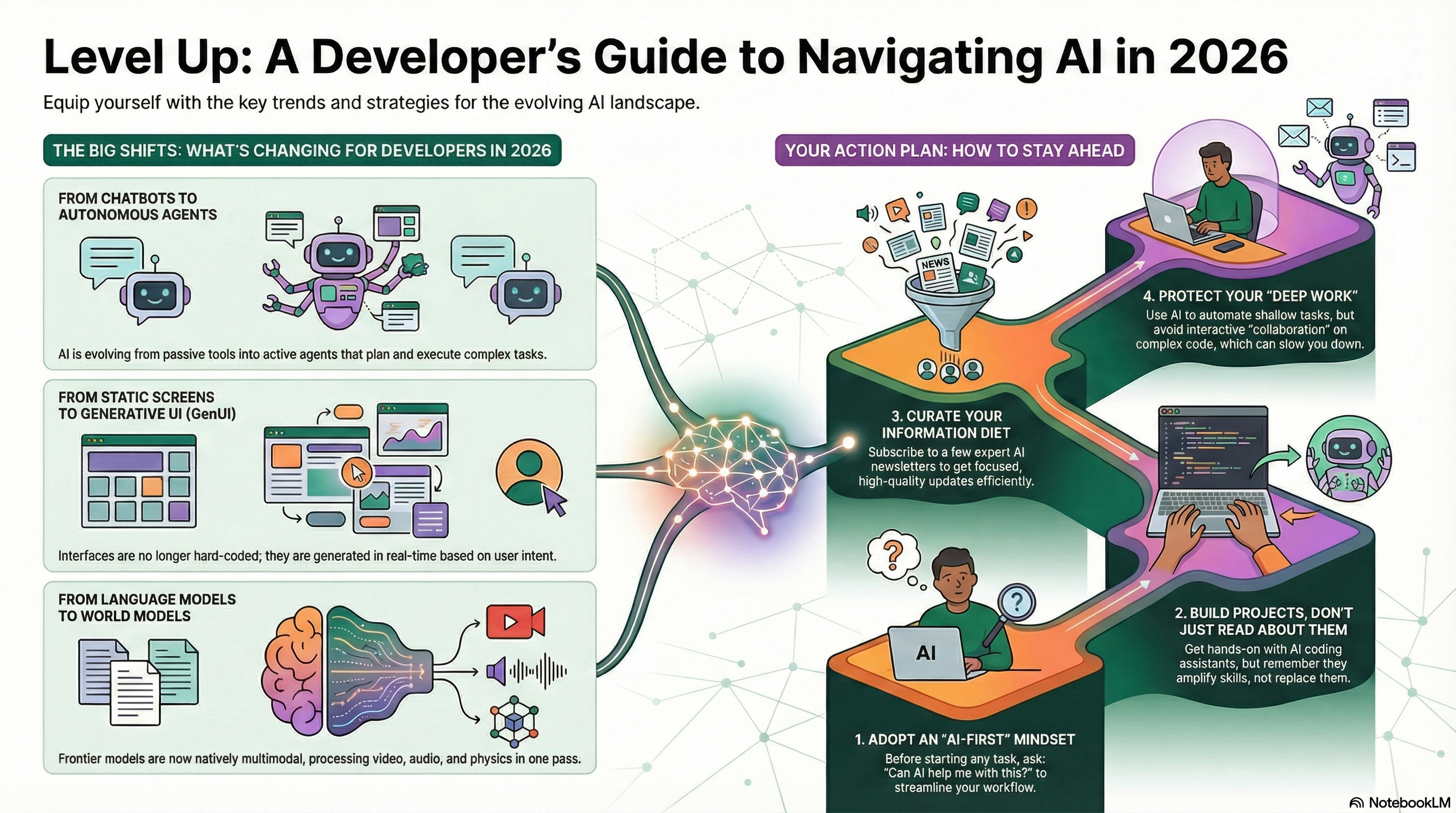
10 things software developers can do to keep up to date and on top of new and changing AI innovations and tools in 2026.
1. Master agentic coding tools like Claude Code and the Interactions API to move beyond simple code completion toward autonomous multi-step development workflows.
2. Transition from “Conversational UI” to “Delegative UI” architectures by designing systems where users assign high-level goals to autonomous AI agents rather than just exchanging chat prompts.
3. Adopt “Repository Intelligence” by utilizing AI that analyzes patterns across entire code repositories—understanding relationships, history, and context—to catch errors earlier and automate routine fixes.
4. Design for Generative UI (GenUI), moving away from hard-coded static screens toward bespoke micro-interfaces drawn in real-time by AI based on a user’s specific intent and history.
5. Optimize software for the “AI PC” and local NPUs to handle “Physical AI” tasks like real-time gesture tracking and to reduce “inference debt” by moving heavy lifting from the cloud to local silicon.
6. Track specialized technical benchmarks such as the LM Arena and Design Arena to identify which specific model versions (e.g., GPT-5 or Gemini 3 Pro) are currently superior for frontend coding and reasoning tasks.
7. Integrate Explainable AI (XAI) features, such as counterfactual explanations, into your applications to improve user reliance and accuracy by showing how specific attribute changes would alter the AI’s decision.
8. Adopt an “AI-First” mindset for pair programming by using techniques like “microdumps” (providing bulk context to keep the AI on the same page) or “ask me what I know” to efficiently collect information for documentation.
9. Protect your capacity for “Deep Work” by being wary of the “cybernetic collaboration” trap, where the constant back-and-forth dance with a chatbot can reduce the gear at which your brain operates and slow down high-value creation.
10. Follow authoritative research newsletters like The Batch by DeepLearning.AI for evidence-based insights into research breakthroughs (such as continuous learning or new scaling laws) without the distraction of marketing hype.
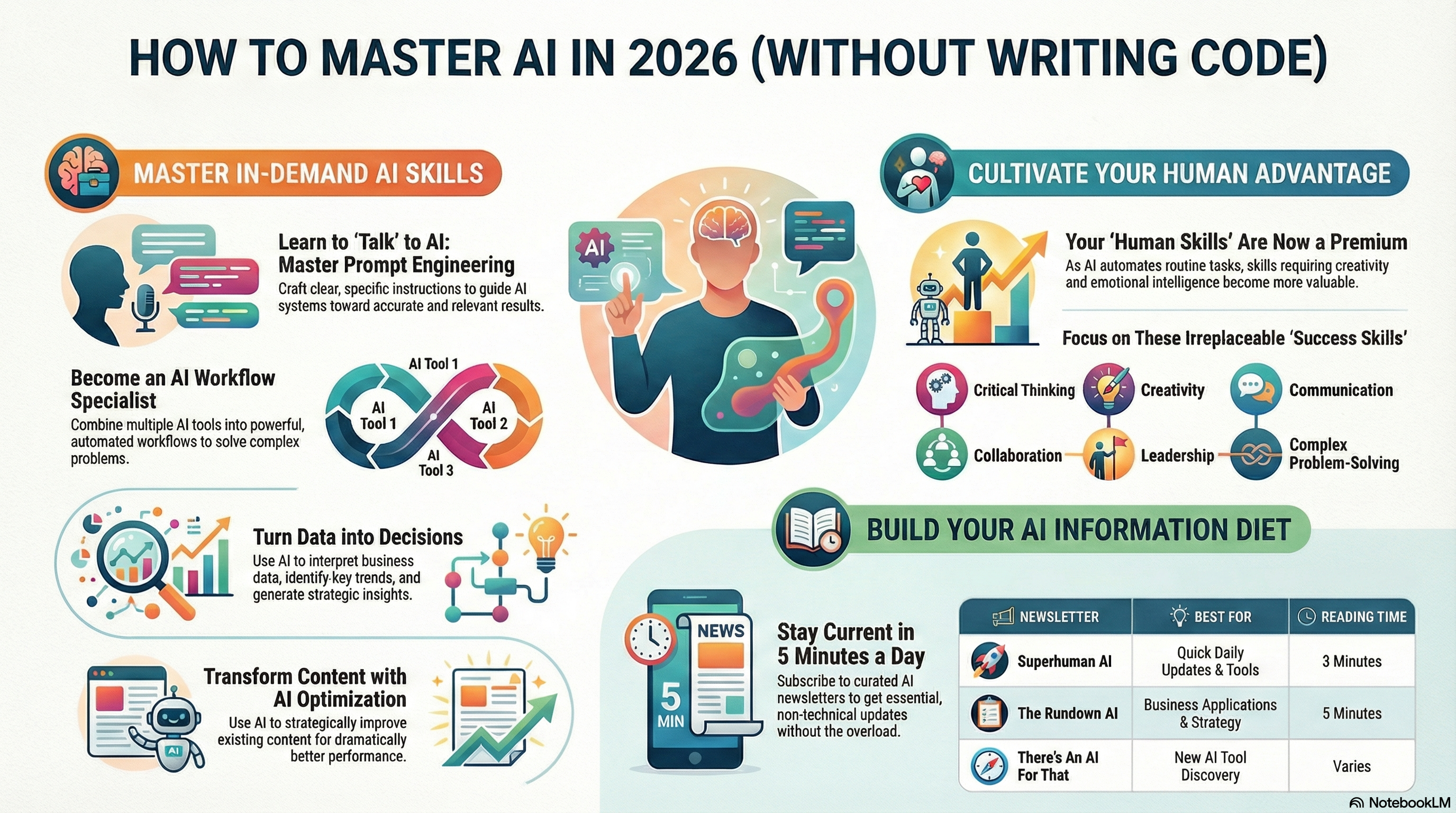
10 things non-programmers can do to keep up to date and on top of new and changing AI innovations in 2026.
1. Subscribe to top-tier AI newsletters such as Superhuman AI for daily 3-minute updates or The Rundown AI to understand practical business applications and implementation strategies.
2. Be prepared to switch AI providers every few months to ensure access to the rapidly moving frontier, as technical leads between labs like OpenAI and Google often evaporate in weeks.
3. Use model aggregator services like Freepik, Higgsfield, or Krea for image and video generation, which provide access to new cutting-edge models within days of their launch across different providers.
4. Master the art of prompt engineering by learning to structure precise, audience-specific instructions that turn generic “AI slop” into valuable professional results.
5. Adopt a “Delegative UI” mindset by learning to assign autonomous AI agents specific goals and multi-step tasks rather than simply using AI as a passive conversational chatbot.
6. Invest in an AI capable computer with a dedicated Neural Processing Unit (NPU) to handle “Physical AI” tasks like real-time gesture tracking and local data processing, which prioritizes privacy and reduces cloud-based “inference debt”.
7. Develop “AI tool integration” skills by using platforms like make.com to connect different AI tools into powerful, automated workflows that solve real business problems without writing code.
8. Focus on building “Success Skills” such as critical thinking, leadership, and human-centric judgment, as these remain vital moats for human workers even as AI accelerates routine execution.
9. Follow vertical AI platforms that wrap commoditized models in highly specific, defensible workflows for domains like legal discovery, medical triage, or supply chain optimization.
10. Track crowdsourced benchmarks like the LM Arena or Design Arena to identify which models are truly performing best for specific tasks based on real-time user preference votes.
Personal skills that are still required that may not be supplied by AI in 2026.
As AI transitions from a tool to a teammate in 2026, human value will migrate “upstream” toward high-level cognitive and emotional capacities that machines cannot replicate. While AI excels at routine execution, the following personal skills remain vital human “moats”.
1. Complex Judgment and Decision-Making: As AI accelerates execution velocity, judgment becomes the primary professional bottleneck. Humans are uniquely required to verify the quality of AI work, as it is often harder to audit an agent’s 50-step logic than to produce the work oneself.
2. Emotional Intelligence (EQ) and Authentic Empathy: AI can simulate empathy, but it cannot genuinely experience emotions or form the authentic connections that are essential for deep human relationships. True EQ serves as a “renewable infrastructure” for resilience, helping people navigate the stress of technological displacement.
3. High-Bandwidth Communication: While AI handles low-bandwidth “connection” like text, humans remain superior at high-bandwidth “conversation”. This involves processing nuanced analog cues—such as tone of voice, facial expressions, and body language—which are necessary for empathy and deep understanding.
4. Strategic Leadership and Mentorship: Future workplaces will require humans to lead hybrid human-machine teams, acting as “coaches” rather than just managers. Humans must serve as adult role models, providing the guidance needed to keep others “on track” when AI handles the actual instruction.
5. Problem Definition and Framing: A critical skill is AI-assisted problem solving, which involves defining a business problem in a way that AI can effectively tackle. Humans must determine “what” should be made and “why” it matters, rather than just focusing on “how” to build it.
6. Ethical Accountability: AI can follow rules, but humans must take responsibility for outcomes, ensuring that systems optimize toward goals that align with societal values. This includes the ability to recognize and contest algorithmic gaslighting or “empathy entrapment” used by manipulative AI systems.
7. Creative Meaning-Making: Human contribution will center on holding the goals and identifying core values that transcend specific job roles. This “meaning-making” function allows individuals to find purpose in creative and relational work even as routine cognitive tasks become automated.
8. Critical Thinking and Source Verification: Users must maintain the ability to audit AI outputs for hallucinations and bias. Developing “human-centric judgment” is necessary to understand how people actually behave, rather than relying on how AI thinks people behave.
9. Adaptability and Resilience: The pace of AI change requires a “growth mindset” to continuously learn new tools without succumbing to “Review Fatigue” or digital overwhelm. This involves “Attention Activism”—the intentional choice of where to direct focus in an attention economy designed to capture it.
10. Productive Solitude: To thrive, individuals must maintain the capacity for solitude, which allows the brain to process complex emotions and clarify goals free from “input from other minds”. This state of reflection is necessary to build the moral courage required to navigate an unpredictable technological landscape.