Note: This blog was created in advance of this week’s White Rabbit Ashland Clubhouse Rogue Valley AI Lab session titled: “RVAI Lab: The Data Center Dilemma” Thursday, July 2, 2026 from 5:30 PM – 7:00 PM. White Rabbit Clubhouse 5 North Main Street, #2, Ashland, OR
About This Event:
Data centers have become the flashpoint for anti-AI sentiment — the place where abstract worries about artificial intelligence turn into very concrete fights over power, water, and land. The reaction is understandable. It also tends to generate more heat than light. This month the Rogue Valley AI Lab goes straight at it. Matt and Anna Strombom join us to demystify data centers: what they actually are, how they work, what they consume, and where they’re headed as the build-out accelerates. Then the harder question underneath it all — can we build data centers that don’t chafe against our values and the stewardship we seek with the places we live? Few topics matter more for us to make better sense of, together, and to rise above the easy answers in either direction. Come ready to learn, to question, and to think it through with your neighbors.
This is the Rogue Valley AI Lab’s free, biweekly meetup — for anyone curious about AI, from seasoned builders to the AI-curious. Come for the ideas, stay for the conversation.
Across the landscape, AI is manifesting as massive, windowless fortresses that demand staggering amounts of power and water.
The promise of Artificial Intelligence is marketed as an ethereal, weightless revolution—a “cloud” of algorithms solving humanity’s problems in the digital ether. But as the investigative lens zooms in, the abstract becomes concrete. Across the landscape, AI is manifesting as massive, windowless fortresses that demand staggering amounts of power and water. This is the “heat vs. light” tension of the 21st century: we crave the enlightenment of AI, but we are fundamentally unprepared for the physical heat it generates.
As a civic futurist, I see a landscape cluttered with disinformation. To understand the true impact of these facilities, we must look past the architectural renderings to the legal, ecological, and economic gears turning beneath. Moving past the noise reveals that the “AI boom” is less a technological inevitability and more a series of high-stakes policy choices.
1. Your Utility Bill Isn’t an Automatic Victim (If the Law Has Teeth)
The fear that residents will subsidize industrial power needs is the most common flashpoint in town halls. However, the difference between a community being “drained” and being “protected” lies in the fine print of utility law.
In Kansas, the Corporation Commission (KCC) and SB 98 have created a regulatory shield. Under new large-load tariff rules, users drawing 75 MW or more are not only barred from standard economic development discounts but are actually expected to pay 7–10% more than existing industrial customers on annual power bills that often exceed $200 million. By requiring 12-to-17-year contracts, 80% minimum take-or-pay clauses, and collateral equal to two years of bills, Kansas is shifting the risk of “stranded costs” from the grandmother in Wichita to the developer in Silicon Valley.
The Investigative Reality: This is a sharp contrast to Virginia, where Dominion Energy proposed a 2025 rate hike of roughly $8.51 per month for typical households, citing data center infrastructure as a primary driver. Without the specific legal protections found in Kansas, a “documented national pattern of concern” is emerging where residents indeed foot the bill for the grid’s industrial expansion.
2. The “Thirsty AI” Narrative is a Choice, Not a Fate
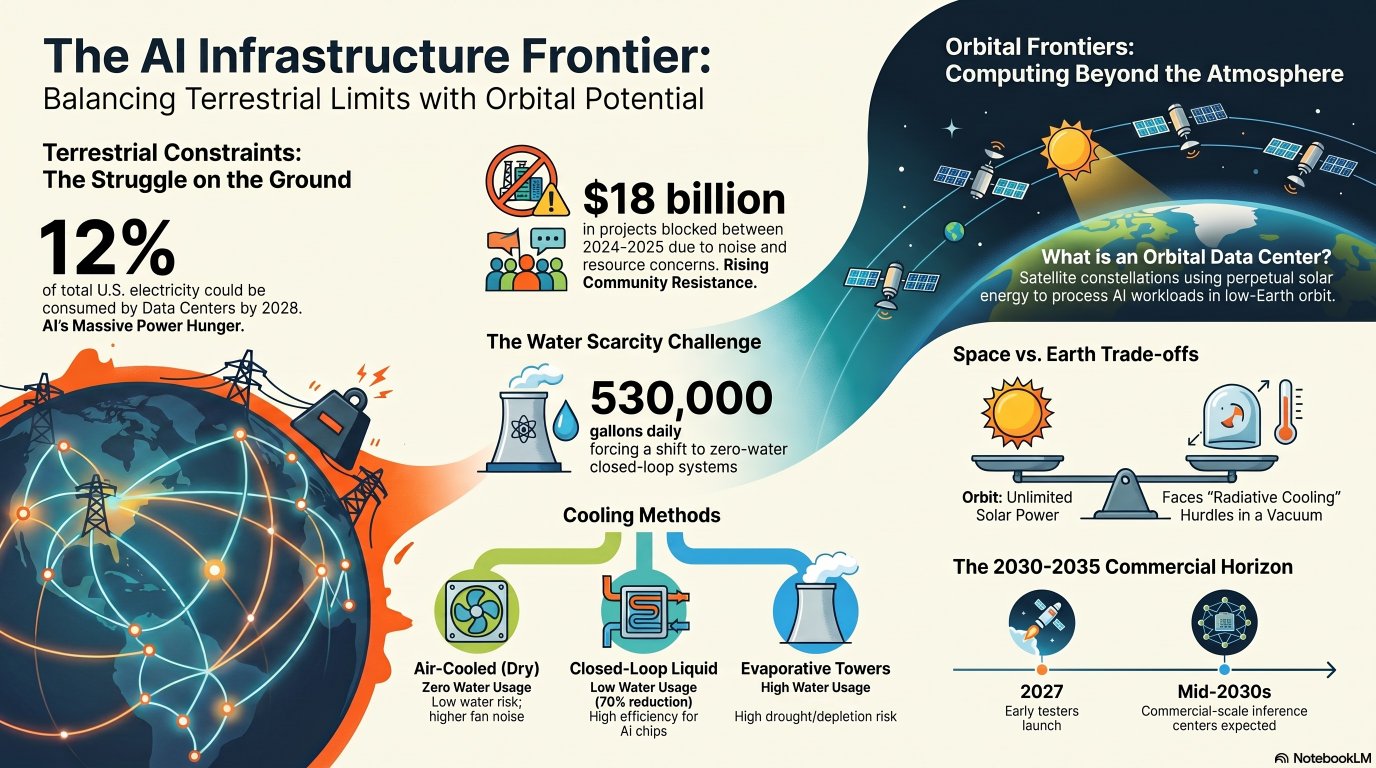
The claim that AI will inevitably dry up local rivers assumes developers will default to 1970s-era evaporative cooling. While these older systems can gulp 530,000 gallons per day, the shift toward “dry cooling” and “closed-loop” technology is a market reality—if demanded. Microsoft, for instance, has committed to zero-water evaporation designs for all new builds starting in late 2024.
However, the scale of the challenge remains staggering. In the UK, the Environment Agency projects a daily water deficit of nearly 5 billion liters by 2050—a shortfall representing over a third of the current public water supply. The conflict isn’t just about volume; it’s about the competition for potable (drinking) water.
Quote Integration: As the UK’s planetary impact reports make clear, the current explosion of AI systems is occurring “generally without much regard for resource efficiency.” This is a systemic market failure. Sustainability only happens when communities negotiate for non-potable sources, such as Google’s reliance on wastewater for 25% of its campuses.
3. Data Centers Don’t Want Your Jobs; They Want Your Ecosystem
We must confront the “Job Paradox.” A massive campus may employ 1,000 workers during a decade of construction, but once the servers are humming, it only needs 100 to 200 permanent staff. Furthermore, investigative data from the New York Times suggests that these “long-term and higher-paying employment opportunities aren’t usually local.”
To survive this, regions must treat negotiations as “ecosystem-shaping moments” rather than “real estate transactions.” Look at the CoreWeave project in New Jersey: it was structured as part of an AI Hub with Princeton University, including a $20 million commitment to local startups.
Analysis: Data centers are infrastructure anchors. They generate a 7.4 ancillary job multiplier (CBRE/Brookings data) in cybersecurity and fiber expansion, but only if the community “negotiates for the ecosystem” rather than just the property tax.
4. The Sound of AI is a 24/7 Low-Frequency Reality
As tech critic Gerry McGovern bluntly puts it, “Data Centers Are Noisy as Hell.” While a source dBA of 55–75 sounds comparable to a dishwasher or lawn mower, the “investigative truth” is the duration. A lawn mower stops; a data center hums 24 hours a day, 365 days a year.
This low-frequency reality is an engineering challenge that requires proactive zoning. Fairfax County, VA, has set the standard: 200-foot setbacks and 30-foot acoustic walls that achieve an 11 dBA reduction. Noise isn’t a manufactured concern—it’s a byproduct of a 24/7 industrial process that requires strict regulatory boundaries before the first stone is laid.
5. The “Rural South” is the New Silicon Valley
We are seeing a massive geographic migration. According to Pew Research and the New York Times, there are now over 1,500 U.S. data centers in the pipeline, and the rural South—Texas, Virginia, and Georgia—is the epicenter. This shift is turning agricultural zones into industrial hubs overnight.
The human cost is captured in sites like Project Sail in Coweta County, Georgia. As resident Steve Swope notes, families who moved for a “quiet, rural lifestyle” now face “10 years of ongoing construction” and the potential destruction of property values due to rezoning ancestral homes. The “cloud” is landing on the very places people went to escape the industrial world.
6. These Buildings Can Actually Save the Power Grid (In Theory)
Counter-intuitively, these facilities can act as “grid stabilizers.” Startups like Verrus are designing centers to send power back to the grid during peaks, while the DOE’s DCFlex project (partnering with Google, Meta, and Duke Energy) is proving that data centers can shift workloads to off-peak hours.
The urgency for this technology is real. In July 2024, a voltage fluctuation in Northern Virginia caused 60 facilities to disconnect simultaneously, creating a 1,500 MW surplus that nearly triggered a cascading blackout. This event is why “Fault Ride-Through” (FRT) capabilities are no longer optional—they are a requirement for grid survival.
7. The “Sludge” is a Myth, but Temperature is a Fact
Claims of “black sludge” or toxic waste are generally unfounded. However, the thermal reality is an ecological crisis in the making. Water discharged from these facilities is often high in minerals and significantly higher in temperature.
This thermal pollution pushes native species, specifically riverflies, beyond their tolerance thresholds. In a warming world, this heat creates “competitive generalist” environments where invasive species thrive at the expense of local biodiversity. The issue isn’t “toxicity” in a chemical sense; it’s the disruption of the thermal balance of our waterways.
Space-Based Data Centers
Orbital data centers involve placing computer servers, data storage systems, and AI accelerators into satellites—often in low-Earth orbit (LEO)—to function as a digital infrastructure network in space. As the tech industry faces mounting resource limitations on Earth, deploying data centers in space presents a mix of unprecedented opportunities and formidable engineering challenges.
The Opportunities of Space-Based Data Centers
- Unlimited, Unconstrained Power: Terrestrial data centers are exacerbating a global power crisis, facing multi-year queues to connect to strained electrical grids. In space, particularly in dawn-dusk sun-synchronous orbits, solar panels receive nearly constant sunlight, making them up to eight times more productive than on Earth.
- Zero Water Footprint: Hyperscale data centers on Earth evaporate millions of gallons of fresh water daily to cool their servers, causing severe friction with local communities. Because space-based data centers reject waste heat through radiation rather than evaporation, they require absolutely no water.
- Bypassing Local Zoning and Permitting: Launching infrastructure into orbit entirely sidesteps the terrestrial battles over land use, municipal zoning, environmental reviews, and grid interconnection that are currently stalling ground-based development.
- In-Orbit Data Refinement: Orbiting telescopes and observation satellites generate massive volumes of raw data. Processing this data directly in space allows satellites to instantly extract insights and discard irrelevant information, massively reducing the bandwidth needed to transmit data back to Earth. This accelerates decision-making for latency-sensitive applications like wildfire detection, precision agriculture, and maritime surveillance.
- Resilience and Digital Sovereignty: A space-based data center network acts as a physically isolated digital backbone. This protects critical government, defense, and financial data from terrestrial natural disasters, physical infrastructure attacks, and geopolitical disruptions. It also enables continuous cloud access for remote maritime, aviation, and polar regions.
The Issues and Engineering Challenges
- Prohibitive Launch Costs and Mass: The economic viability of orbital data centers is an existential hurdle. At current prices of roughly $1,500 to $2,900 per kilogram, deploying orbital compute is several times more expensive than building equivalent terrestrial capacity. Large-scale commercial viability is highly dependent on next-generation, rapidly reusable rockets driving launch costs down to the $100 to $500 per kilogram range.
- The “Vacuum Insulator” Cooling Problem: While space is cold, a vacuum is a near-perfect thermal insulator. Rejecting megawatt-class waste heat purely through infrared radiation is highly inefficient, requiring massive radiators that can weigh up to 10 times more than the servers themselves, which drastically inflates launch costs. Furthermore, dense satellite clusters required for high-speed computing face a “Proximity-Thermal Paradox.” Tightly packed satellites cast thermal shadows on one another, creating heat traps that cause thermal throttling and degrade hardware lifespans.
- Hardware Degradation and Inability to Upgrade: Space radiation randomly corrupts data and rapidly degrades commercial computing hardware. On Earth, AI chips become obsolete and are refreshed every one to three years; in orbit, satellites cannot be easily retrieved or repaired. This creates a high risk of premature hardware failure, turning expensive infrastructure into space e-waste.
- Latency and Workload Limitations: Round-trip signal delays between Earth and LEO impose hard physics-based speed limits. While some industry experts suggest space could eventually host AI training, others note that frontier-model AI training requires microsecond-tight coupling between thousands of chips. This latency barrier currently limits orbital data centers primarily to inference, batch processing, and storage workloads.
- Orbital Congestion and Debris: With over 17,000 satellites and 44,000 tracked objects already in orbit, deploying thousands or even millions of data center satellites drastically increases the risk of orbital collisions and can interfere with astronomical research.
- Legal and Regulatory Gray Zones: Terrestrial data centers are strictly regulated through energy tariffs, local land-use laws, and environmental review regimes. Space law, founded on the Outer Space Treaty of 1967, regulates discrete events like rocket launches and re-entry, providing virtually no framework for supervising continuous industrial operations. This legal vacuum could result in “flags of convenience,” where operators register satellites in nations with the most lenient tax or data rules to bypass regulations like GDPR, complicating data sovereignty and oversight.
The Social License to Operate everywhere, even in Space!
The fundamental failure of the AI boom is a planning failure. In the UK, 2025 water resource plans were finalized without even accounting for the burgeoning demand of data centers. Now, as the UK government grants data centers “Critical National Infrastructure” (CNI) status—placing them on equal footing with emergency services—the government inherits a moral and legal responsibility for their impact.
CNI status should not be a “get out of jail free” card for planning restrictions; it must be a mandate for the highest standards of stewardship. If we are to grant these buildings the same status as our water and hospitals, we must demand they meet a “social license to operate.” Sustainability in the AI age is a design choice, and it is time we stopped letting the “heat” of rapid expansion overwhelm the “light” of our communal resources.
Space-Based Data Centers (Orbital Data Centers) represent a radical proposed solution to the escalating resource demands of artificial intelligence. By placing computer servers, data storage, and AI accelerators into satellites, the tech industry aims to create a digital infrastructure in space that bypasses the severe power grid constraints, massive water consumption, and land-use battles currently bottlenecking data centers on Earth.
AI Data Center FAQ(S)
Last Updated: Thursday, July 2, 2026
Cooling, Water Consumption
What cooling technologies can reduce data center water consumption?
To reduce the massive water footprint of data centers, the industry is transitioning away from traditional evaporative cooling towers and adopting several advanced, water-efficient technologies:
- Air-Cooled (Dry Cooling) Systems: These systems use outdoor air to cool the facility and require absolutely zero water, achieving a perfect Water Usage Effectiveness (WUE) of 0. For example, Meta utilizes an air-side economizer design that draws in filtered outdoor air, allowing their facilities to use 50% less water than typical data centers.
- Closed-Loop Liquid Cooling: In a closed-loop system, water circulates internally within a sealed network and is reused continuously rather than being lost to evaporation. This approach can reduce freshwater consumption by up to 70%. Microsoft has adopted zero-water evaporation closed-loop designs for its new data centers to drastically cut water usage.
- Direct-to-Chip and Immersion Cooling: Designed for the extreme heat of modern AI hardware, these methods either flow liquid directly over chips via cold plates or submerge entire servers in a specialized dielectric fluid. Because liquid absorbs heat far more effectively than air, these systems can run at warmer temperatures and reject heat using “dry coolers” instead of water-evaporating chillers. Over their life cycles, cold plate and immersion technologies can reduce water usage by 31% to 52% compared to traditional air cooling.
- Hybrid Cooling Systems: These systems offer a balanced approach by relying primarily on air cooling for most of the year, only switching to water-based cooling during peak heat periods or extreme weather to optimize both energy and water use.
- Non-Potable Water and Reclaimed Water: While not a cooling mechanism itself, many data centers are reducing their impact on local drinking water supplies by utilizing alternative water sources. This includes treating and using industrial or agricultural wastewater, rainwater harvesting, greywater recycling, or partnering with local utilities to use reclaimed water for their cooling processes.
- Space-Based Data Centers: As a radical, forward-looking solution, companies are exploring orbital data centers. Because these satellites reject waste heat directly into the vacuum of space through infrared radiation rather than evaporation, they inherently possess a zero water footprint.
What are the common myths about data center water pollution?
The most prominent myth regarding data center water pollution is the claim that these facilities discharge heavily contaminated “black sludge” or untreated industrial waste that severely pollutes local drinking water supplies.
In reality, there is no documented evidence to support the “black sludge” characterization. When data centers do discharge water as part of routine cooling system maintenance, the wastewater typically only contains:
- Concentrated minerals and dissolved solids from the cooling process.
- Small amounts of standard treatment chemicals used to prevent scaling or biological growth.
- Elevated water temperatures relative to the incoming supply.
These discharge characteristics are not unique to data centers; they are essentially the same as those of standard cooling systems used in many other industrial and commercial facilities.
Furthermore, data centers are strictly prohibited from discharging untreated waste into drinking water systems and must adhere to established regulatory frameworks. Their wastewater is managed through:
- Regulatory Oversight: Direct discharges to surface waters are governed by National Pollutant Discharge Elimination System (NPDES) permits, which enforce strict chemical and temperature limits. They are also subject to state environmental permits and local wastewater utility standards.
- Mandatory Pretreatment: Facilities discharging into municipal sewer systems are frequently required to pretreat their wastewater onsite (using established engineering solutions like reverse osmosis or membrane bioreactors) to ensure it complies with local treatment plant standards before it is released.
Additionally, modern data center engineering is increasingly moving away from systems that generate wastewater. New facility designs frequently incorporate technologies—such as closed-loop cooling, direct-to-chip liquid cooling, and air-cooled systems—that drastically reduce or completely eliminate water discharge.
How is the UK addressing AI’s impact on water security?
The UK’s approach to addressing the impact of artificial intelligence on water security is currently a mix of developing policies, internal government strategies, and calls for stricter regulations, all set against the backdrop of a looming national water shortage.
The UK is projected to face a daily water deficit of nearly 5 billion liters by 2050, and the rapidly growing water demands of AI data centers—used primarily for cooling and electricity generation—are exacerbating this vulnerability.
Here is how the UK is currently navigating this challenge:
Addressing Policy Gaps and Planning Currently, a significant policy gap exists: the statutory Water Resources Management Plans (WRMPs) developed by water companies do not explicitly account for the water needs of novel infrastructure like AI data centers. To address this:
- The Environment Agency (EA) has acknowledged that data center demand is “highly uncertain” and has urged operators to actively forecast their water consumption and explore alternative sources, such as water reuse.
- The 2025 National Framework for Water Resources: The UK government is set to publish its next iteration of this framework in 2025. Experts and policymakers view this as a critical window to explicitly integrate data center water demand into the country’s long-term water planning.
- The Environment Act 2021: This act provides an overarching legal framework that includes a statutory target to reduce non-household water use by 9% by 2030, which encompasses industrial facilities like data centers, though current plans are falling short of this target.
Internal Government ICT Strategies The UK government is attempting to lead by example by embedding water efficiency into its own operations:
- Greening Government Commitments (GGCs) & ICT Strategy: These frameworks mandate sustainable development principles in the procurement and operation of all central government IT.
- 2025-2030 Sustainability Strategy: The Department for Environment, Food and Rural Affairs (Defra) is finalizing the Government Digital Sustainability Strategy for 2025-2030. This presents a prime opportunity to embed specific water consumption targets and requirements into government technology procurement.
- Government Digital Sustainability Alliance (GDSA): This collaborative body brings together government specialists, suppliers, and academics to identify risks and promote sustainable digital practices across the government’s IT estate.
A Critical Policy Tension: CNI Status Complicating these conservation efforts is a recent policy shift. In September 2024, the UK government officially designated data centers as Critical National Infrastructure (CNI), placing them on equal footing with essential services like water and emergency systems. While this aims to boost business investment and resilience, it creates a severe policy tension: CNI status implies fewer planning restrictions, meaning data centers will likely face fewer restrictions on water access, even in areas already designated as “seriously water stressed”.
Expert Calls for Mandatory Reporting A major hurdle for the UK is a pervasive lack of transparency; currently, there is no reliable data on the exact quantity of water used by data centers. In response, organizations like the National Engineering Policy Centre are strongly urging the UK government to introduce mandatory, location-based reporting for data centers. This would require tech companies to publicly report their energy and water consumption (distinguishing between drinking water and non-potable sources) to help target efficiency requirements and prevent developers from exacerbating local droughts.
Using AI to Protect Water Security While AI’s infrastructure threatens water supplies, the UK is simultaneously leveraging AI technology as a tool for environmental protection. New AI technologies are currently being deployed in the UK to detect harmful pollutants in lakes, forecast water quality and flood scenarios in real-time, optimize electricity grid management (which indirectly saves water), and identify facilities that are violating environmental regulations.
What Are other countries besides the US and UK doing to protect citizens from the impacts of AI Data Center Development and impacts on water, electrical grid, etc?
To protect citizens and local resources from the immense strain of AI data center development, many countries outside of the US and UK are implementing strict regulatory frameworks, efficiency mandates, and innovative resource-sharing initiatives.
Here is how various global regions are managing the impacts on water, electrical grids, and communities:
The European Union: Strict Mandates and Waste Heat Recovery
The European Union has taken a highly proactive, regulatory approach to data center sustainability.
- Mandatory Reporting and Water Disclosure: Under the EU’s revised Energy Efficiency Directive (EED) of 2023, data centers with an IT load above 500 kW are legally required to measure and report their energy performance, including their Power Usage Effectiveness (PUE), Water Usage Effectiveness (WUE), and use of waste heat. Furthermore, the EU has implemented mandatory disclosure of water consumption for data center operators under its Common Union Rating Scheme, ensuring transparent, location-based reporting.
- Germany: Germany enacted the Energy Efficiency Act in 2023, setting concrete, legally binding efficiency limits. Existing data centers must reach a PUE of 1.3 or lower by 2030, and any new data center from 2026 onwards must achieve a PUE of 1.2 or lower. The law also mandates that new data centers reuse at least 10% of their waste heat by 2026, rising to 20% by 2028.
- Moratoriums in the Netherlands and Ireland: Both countries instituted temporary policy moratoriums on new mega-data centers between 2019 and 2022 to protect their grids and resources, and they now require strict sustainability plans for any approvals. The Amsterdam city council has taken an even harder line, stating it will only consider new data center developments from 2035.
- Finland’s Tax Reversal: To curb unchecked energy consumption, the Finnish government abolished tax breaks on electricity for data centers in March 2025, dramatically raising their rate from 0.05 cents per kWh to the standard 2.24 cents per kWh.
- District Heating Contributions: Across the Nordics, governments and utilities are partnering with tech giants to use data center waste heat to warm local homes, offsetting local grid strain. For example, Meta’s facility in Odense, Denmark, heats over 12,000 homes, helping the local utility phase out a coal plant. In Finland, Google provides waste heat free of charge to cover 80% of the local district heating demand in Hamina, while a new Microsoft facility in Espoo is being built to heat 250,000 people.
Asia: Capacity Limits and Technological Solutions
- Singapore: After freezing new data center construction from 2019 to 2022 due to land and energy constraints, Singapore now only allows new builds under incredibly strict criteria. Facilities must have a PUE of 1.3 or lower, use innovative cooling methods (like immersion cooling), and include plans to offset carbon emissions and use renewable energy.
- China: The Ministry of Industry and Information Technology (MIIT) established a target requiring large cloud data centers to achieve a PUE of 1.3 or lower by the end of 2023, with provinces like Guangdong tightening this to 1.25 for new projects by 2025. China is also exploring the use of Liquefied Natural Gas (LNG) infrastructure, utilizing the cold energy from LNG regasification to cool data centers, which has reportedly reduced cooling electricity consumption by over 50% in pilot projects.
- India: The Bureau of Energy Efficiency (BEE) is currently developing formal energy performance benchmarks specifically tailored for data centers to regulate future growth.
Latin America: Conditional Growth and Strategic Planning
As hyperscalers expand into South America, local governments are beginning to tie economic incentives directly to environmental stewardship.
- Chile: In 2025, the Chilean Government began implementing its National Data Center Plan to boost environmental standards. This includes deploying a digital tool that identifies land, energy, water, and socio-economic factors to guide zoning, alongside strict guidance on permitting and environmental requirements.
- Brazil: To attract infrastructure while protecting its resources, the Brazilian government introduced the “Redata” scheme. While it offers federal tax suspensions on imported equipment, it legally binds developers to sustainability obligations, including the mandatory use of clean energy and specific targets to reduce water consumption.
Space Based Data Centers
How does space law differ from terrestrial infrastructure regulation?
The regulation of space-based infrastructure differs fundamentally from terrestrial infrastructure because terrestrial law is anchored to physical location and continuous oversight, whereas space law is built around national authorization and discrete events.
Here is a breakdown of how the two regulatory frameworks contrast:
Terrestrial Infrastructure Regulation (Place-Based & Continuous)
On Earth, data centers are regulated as physical infrastructure through three primary, overlapping regimes that provide continuous oversight:
- Energy Regulation: Terrestrial facilities are treated as end-use electricity customers. They are subject to utility tariffs, grid interconnection rules, and capacity planning overseen by state public utility commissions and the Federal Energy Regulatory Commission (FERC).
- Environmental Review: Construction and expansion often trigger environmental reviews assessing localized impacts, such as water usage, emissions, and noise pollution.
- Local Land-Use and Zoning: Facilities are governed by municipal planning frameworks, requiring zoning approvals, building permits, and adherence to community impact conditions.
Space Law (Attribution & Discrete Events)
Space law operates without the geographical boundaries that anchor terrestrial regulation. Its core framework relies on the Outer Space Treaty of 1967, which dictates that space belongs to no single nation, but states are internationally responsible for the spacecraft launched under their registry.
- Regulating Events, Not Operations: Space law regulates discrete events—such as launch safety, orbital collisions, and re-entry—rather than the continuous, day-to-day operation of industrial infrastructure.
- Lack of a Central Regulator: There is no global space regulator or doctrine aimed at supervising ongoing industrial-scale computation in orbit. Space law enforces rules indirectly through diplomatic channels and state-to-state responsibility, rather than through agencies with continuous supervisory authority.
- Bypassing Earth’s Rules: Because orbital facilities do not connect to terrestrial power grids or sit on municipal land, they are completely exempt from utility oversight, rate regulation, and zoning laws.
The “Flags of Convenience” Loophole
Because space law was designed for exploration and state coordination rather than industrial-scale computation, putting data centers in orbit creates massive legal gray zones. A space-based data center is essentially treated like a ship at sea, governed by the laws of the country where it is registered.
This creates a high risk for “flags of convenience,” where operators might register their satellite data centers in nations with the most lenient tax or data privacy laws to bypass strict terrestrial regulations, complicating data sovereignty and oversight frameworks like the GDPR.
What is the ‘flags of convenience’ loophole in space law?
The “flags of convenience” loophole in space law arises from how jurisdiction is assigned to spacecraft. Under the 1967 Outer Space Treaty, space belongs to no single nation, but the state where a spacecraft is registered retains “jurisdiction and control” over it.
This means a space-based data center operates much like a ship at sea, governed entirely by the laws of its “flag state”. Consequently, operators can exploit this by choosing to register their satellite data centers in countries with the most lenient data privacy, artificial intelligence, and tax regulations, while continuing to serve users globally.
This loophole creates severe complications for terrestrial regulations and data sovereignty:
- Regulatory Clashes: While terrestrial data laws like Europe’s GDPR follow the data rather than the physical hardware, having data processed in an orbit governed by a different nation’s laws creates a legal traffic jam. Multiple countries could plausibly claim legal authority over the same computing job, and current space treaties offer no tiebreaker for these disputes.
- Lack of Auditing and Oversight: Existing space treaties were designed to assign liability for discrete physical events, like falling space debris, rather than to supervise continuous industrial computation. Furthermore, it is currently unclear how any nation or regulatory body would practically audit an autonomous AI facility orbiting hundreds of kilometers above Earth with no human crew aboard.
Electrical Grid
How can data centers actually help improve electrical grid stability?
While data centers consume massive amounts of electricity, properly integrated and modern facilities can actually serve as significant assets for electrical grid stability. They achieve this through a combination of predictable usage patterns, advanced energy storage, and flexible operations:
- Highly Predictable Power Demand: Unlike residential energy usage, which spikes unpredictably throughout the day, data centers operate at a very high and steady load factor—often around 82%. This steady baseline is a major planning asset for utilities, making it much easier to forecast demand and manage power generation.
- Active Grid Services via Energy Storage: Next-generation data centers integrate large battery storage systems into their Uninterruptible Power Supply (UPS) networks. These systems can provide active grid services such as frequency regulation, voltage support, and demand response. Some facilities are even being designed to send stored power back to the electrical grid during peak demand events, and major companies have pledged to make their backup generation resources available during energy scarcity to prevent community blackouts.
- Workload Shifting and Flexibility: Through initiatives like the Department of Energy’s DCFlex project, operators are demonstrating how computational workloads can be paused or shifted to different locations to reduce power draw when the local grid is stressed. Studies suggest that if data centers accept power curtailment for less than 100 hours a year, the grid could successfully integrate tens of gigawatts of new demand without needing proportionate physical expansions.
- Fault Ride-Through (FRT) Capabilities: Historically, data centers would automatically disconnect from the grid during a voltage fluctuation, which could dump a massive power surplus back onto the network and risk cascading outages. Now, transmission operators are increasingly requiring “Fault Ride-Through” capabilities so that data centers maintain their connection and actively support the grid through short-duration disturbances.
- AI-Powered Grid Analytics: The computing power housed in these centers enables advanced AI analytics that utilities can leverage for grid optimization. Electricity executives anticipate that AI tools will deliver significant improvements in failure reduction, operational productivity, and outage prevention and restoration.
- Funding Infrastructure Upgrades: The sheer scale of data center development drives substantial capital investment into utility infrastructure. By funding the construction of new substations, upgraded transmission lines, and expanded generation capacity, data centers help pay for systemic upgrades that improve overall grid resilience and reliability for all local customers.
Noise Mitigation
What noise mitigation strategies are used for residential areas?
To mitigate the constant, low-frequency noise generated by data center cooling systems and backup generators, developers and local governments employ a combination of engineering, technological, and regulatory strategies:
- Physical Setbacks and Zoning Regulations: Local ordinances can mandate buffer zones to distance facilities from homes. For example, Fairfax County, Virginia, requires 200-foot setbacks from residential areas and mandates both pre- and post-construction noise studies to ensure compliance.
- Acoustic Barriers and Sound Walls: Facilities frequently use structural defenses to block sound from traveling. This includes installing mandatory acoustic barriers for all external equipment and erecting massive acoustic sound walls of 30 feet or higher, which can reduce noise levels by 11 decibels (dBA) at nearby residences.
- Acoustical Shrouds and Blankets: The large exhaust fans and cooling units can be wrapped in sound-reducing acoustical shrouds or blankets. While this is a common approach, it can cost millions of dollars, and it is not always immediately effective; in one instance, a company had to double the thickness of its wraps after residents reported the initial shrouds had virtually no impact.
- Advanced Liquid Cooling Technologies: Transitioning away from traditional air conditioning to liquid and immersion cooling is highly effective for noise reduction. By submerging servers in dielectric fluid or using direct-to-chip liquid cooling, data centers can drastically reduce or entirely eliminate the need for the large, loud air-cooled HVAC equipment and external fans.
- Real-Time Noise Monitoring: To ensure continuous compliance with local noise limits, employing real-time noise monitoring systems with automated alerts has become a standard engineering practice at modern facilities.
Data Center Costs
What is the Ratepayer Protection Act and how would it work?
The Ratepayer Protection Act (H.R. 9340) is a bill introduced in the U.S. House of Representatives in June 2026 by Representatives Evans and Castor. The legislation seeks to amend the Public Utility Regulatory Policies Act of 1978 by establishing a new federal standard to ensure everyday utility customers do not subsidize the massive infrastructure upgrades required by industrial-scale power users.
If passed, here is how the act would work:
- Defines “Large-Load Customers”: The legislation specifically targets non-residential electricity consumers with a peak electric demand of 100 megawatts or more at a single site or campus.
- Mandates Full Cost Recovery: The bill requires that the rates charged to large-load customers be designed to recover the full, incremental cost of any generation, transmission, or distribution upgrades necessary to serve their massive power needs.
- Requires Upfront Financial Assurances: Before an electric utility makes any infrastructure upgrades to serve a large-load customer, the customer must provide upfront financial assurances or contributions to completely cover the upgrade costs.
- Protects Against Stranded Costs: The large-load customer remains financially responsible for the infrastructure upgrade costs even if they terminate their contract early or cease purchasing electricity from the utility.
- Sets an Implementation Timeline: State regulatory authorities and nonregulated electric utilities would be required to commence consideration of this new federal standard within one year of enactment, and they must complete their review and make a final determination within two years. States that have already implemented a comparable standard or have already voted on one are exempt from this timeline.
How do Kansas laws shield residents from data center costs?
Kansas has enacted specific regulations and legislation designed to legally shield residents from subsidizing the massive electricity and infrastructure costs associated with data centers. These protections primarily stem from rules approved by the Kansas Corporation Commission (KCC) and legislation passed in 2025:
Kansas Corporation Commission (KCC) Tariff Rules In November 2025, the KCC unanimously approved new tariff rules for large-load users, such as data centers drawing 75 megawatts or more. These rules ensure the financial risk sits with the data center rather than residential ratepayers through several strict requirements:
- Long-Term Contracts: Data centers must sign energy contracts lasting between 12 and 17 years.
- Minimum Demand Payments: They are required to pay for at least 80% of their contracted power demand, even during months when they use less. This ensures that other ratepayers are protected from covering “stranded costs”.
- Upfront Collateral: Data centers must post financial collateral equivalent to two years of their minimum bills, guaranteeing that the risk of non-payment falls on the company and not local residents.
- Funding Infrastructure Upgrades: These large-load users are required to directly pay for any transmission upgrades needed to serve their facilities. Consequently, the KCC estimates data centers will pay 7% to 10% more than existing industrial customers, absorbing infrastructure costs that might otherwise be pushed onto the general rate base.
Kansas Senate Bill 98 (SB 98) Enacted in 2025, SB 98 provides further statutory protections for ratepayers and taxpayers:
- Prohibition of Discounted Rates: The law explicitly forbids public utilities from offering data centers the standard 40%/20% economic development discounted electricity rates that are typically available to other large industrial customers.
- Additional Oversight for Incentives: Before any public incentives can be awarded to qualifying data center projects, the proposals must undergo mandatory review by the Kansas Intelligence Fusion Center and the Kansas Department of Commerce.
Ultimately, these measures mandate that data centers finance their own infrastructural needs and pay market or above-market rates, preventing residential utility customers from directly subsidizing the facilities.
Besides Kansas, what other states are protecting their citizens from rate increases because of data center construction?
Besides Kansas, several other states have implemented or are exploring measures to ensure that everyday utility customers do not end up paying for the massive infrastructure upgrades required by data centers.
- Pennsylvania: The state recently released a “first-of-its-kind” large-load model tariff. Under these guidelines, utilities must charge large-load customers for any grid upgrades that would not have been needed “but for” their interconnection to the grid, regardless of whether other customers might ultimately benefit from that infrastructure.
- California, Ohio, and Utah: As of 2026, these were the first states to pass legislation explicitly requiring data center developers to bear the financial costs of the new energy infrastructure they necessitate.
- Michigan: In November 2025, Michigan utility regulators approved new large-load rules designed to protect residential ratepayers, similar to the tariff rules approved by the Kansas Corporation Commission.
Broader Trends and Legislative Battles Nationwide, at least 27 states are currently considering or have drafted legislation related to data center development. Many of these states are working to introduce special electric rate classes for data centers, which include strict requirements that the developers fund their own capacity upgrades.
However, these efforts do not always pass. For example, in Washington state, lawmakers introduced a bill that would have required data center operators to cover the costs of energy generation and deployment. While the measure passed the state House, it ultimately died in the Senate after facing public opposition from Microsoft.
Which companies have signed on to the rate payer pledge?
Seven of America’s largest AI companies and data center developers have signed on to the Ratepayer Protection Pledge. The specific signatory companies named in the sources include:
- Meta
- Microsoft
- OpenAI
- Oracle
- xAI
By signing this pledge, these companies have committed to “build, bring, or buy” all the new power generation resources and infrastructure upgrades required to service their data centers, ensuring that everyday consumers are protected from related price hikes.
What is the US Government and Congress doing to protect rate payers?
The US Government and Congress have recently introduced both voluntary and legislative measures designed to protect everyday consumers from the rising electricity and infrastructure costs associated with data centers.
The Executive Branch: The Ratepayer Protection Pledge President Donald Trump issued the Ratepayer Protection Pledge to shield residential utility ratepayers from price hikes tied to data center energy and infrastructure requirements. Executives from seven major tech companies—including Google, Meta, Microsoft, OpenAI, Oracle, and xAI—signed the voluntary pledge. By signing, these companies agreed to:
- “Build, bring, or buy” their own power: Companies commit to paying the full costs of the new energy generation resources needed to satisfy their demand.
- Fund infrastructure upgrades: They agree to pay for all new power delivery infrastructure required to service their data centers so that these expenses are not passed on to ordinary households.
- Negotiate separate rate structures: Companies pledged to negotiate specific rates with utilities and state governments and pay for the power and infrastructure brought online for their facilities, even if they end up not using the electricity.
Congress: Legislative Action Because the Ratepayer Protection Pledge is currently voluntary and non-binding, Congress is working to establish formal legal frameworks.
- Senate Framework: U.S. Senator Marsha Blackburn has been leading a legislative framework aimed at codifying the Ratepayer Protection Pledge into law as part of a broader national AI strategy.
- The Ratepayer Protection Act (H.R. 9340): In June 2026, Representatives Evans and Castor introduced this bill in the House of Representatives. The legislation seeks to amend the Public Utility Regulatory Policies Act of 1978 to create a new Federal standard for “large-load customers,” defined as facilities with a peak electric demand of 100 megawatts or more. If passed, the bill would require these massive data centers to:
- Pay the full, incremental cost of any generation, transmission, or distribution upgrades necessary to serve them.
- Provide upfront financial assurances or contributions to cover the costs of these upgrades before they are even made by the electric utility.
While the federal government is laying this groundwork, experts note that successful implementation will still heavily depend on state-level public utility commissions, which ultimately regulate retail electricity markets and negotiate utility tariffs.
Why are state citizens still being hit with higher electrical bills because of data center construction?
Despite recent initiatives like the Ratepayer Protection Pledge and certain state-level protections, citizens are still experiencing higher electricity bills due to deeply ingrained structural, regulatory, and market factors in the U.S. energy system:
- The Traditional Utility Business Model (Socialized Costs): Historically, when a monopoly utility builds new infrastructure—such as power plants, transmission lines, or substations—the costs are “socialized” and spread out across all of its residential and commercial ratepayers. Because data centers require billions of dollars in new infrastructure, this traditional rate-setting practice effectively forces everyday consumers to subsidize the upgrades.
- Regional Grid Cost-Sharing (Cross-State Subsidies): The U.S. power grid is managed by large regional transmission organizations, such as PJM Interconnection, which covers 13 states and Washington, D.C.. Federal regulations generally require the costs of large transmission network upgrades to be shared across the region based on a “roughly commensurate” standard rather than billing a single facility directly. Consequently, citizens in one state can be billed for data centers built in another. For example, Maryland residents are currently facing a $2 billion charge for grid upgrades that are primarily driven by data center development in Virginia, Ohio, Pennsylvania, and Illinois.
- Wholesale Market Supply and Demand: The immense energy appetite of data centers—which can individually consume as much power as an entire city—is causing demand to rise much faster than new power plants can be built. This supply crunch drives up prices in wholesale electricity markets, which utilities then pass on to consumers. Recently, the PJM region saw its wholesale electricity prices spike by 75.5% (from $77.78 to $136.53 per MWh), an increase federal watchdogs directly attribute to data center load.
- Secret Contracts and Special Deals: Data center developers often bypass standard public rate-setting processes by negotiating confidential, special-deal contracts directly with utility companies. Because these proceedings are hidden from the public, regulators only hear from the utility and the tech companies. Furthermore, regulators are often politically pressured to approve these deals to secure the promised construction jobs and tax revenues, leaving residential consumers without a voice to advocate for fair rates.
- The Limitations of Voluntary Pledges: Initiatives like the White House Ratepayer Protection Pledge are currently voluntary and non-binding. While major AI companies have signed on promising to “pay their own way,” these pledges cannot legally force established monopoly utilities or regional grid operators to change their entrenched cost-allocation rules. Until Congress or state utility commissions pass enforceable legislation, the burden of cost-shifting remains on the average American.
What is the PJM Region?
The PJM region refers to the service area of PJM Interconnection, LLC, which is the largest electricity transmission company and regional grid operator in the United States.
This massive energy region covers 13 states and Washington, D.C., specifically including: Delaware, Illinois, Indiana, Kentucky, Maryland, Michigan, New Jersey, North Carolina, Ohio, Pennsylvania, Tennessee, Virginia, and West Virginia.
In total, the PJM region provides and distributes electricity to approximately 65 million people, which accounts for about 20% of the entire U.S. population.
Data Center Tax Revenue
How much tax revenue do Virginia data centers generate?
Data centers in Virginia generate billions of dollars in tax revenue across both state and local levels. Here is a breakdown of their financial contributions:
State Tax Revenue Data centers contribute more than $1.5 billion annually to Virginia’s state tax revenue. In 2024, they paid an estimated minimum of $929 million in direct state taxes—even after accounting for Virginia’s sales and use tax exemptions—and generated approximately $1.6 billion in total state revenue when factoring in the broader economic activity tied to their construction and operations (excluding corporate income tax).
Local Tax Revenue (Northern Virginia) At the local level, data centers provide a massive boost to municipal budgets, primarily through real and personal property taxes (such as taxes on servers, cooling equipment, and racks). In 2024, data centers paid an estimated $1.3 billion in direct property taxes to localities across Northern Virginia. When combined with the indirect economic activity they stimulate—such as sales taxes, meals taxes, and business license fees—they generated more than $2 billion in local government revenue for the region.
County-Specific Examples
- Loudoun County: As the world’s largest data center hub, Loudoun County received an estimated $663 million in tax revenue from data centers in 2022, which accounted for nearly half of its total property tax revenue. The county’s fiscal analysis estimated that data centers generate about $26 in tax revenue for every $1 in county services they require.
- Prince William County: Data centers generated $166.4 million in local tax revenue for the county in 2023.
Benefits to Residents Because data centers are highly capital-intensive and regularly replace expensive computer equipment, they add substantial value to local tax bases without requiring proportional municipal services. This allows localities to maintain significantly lower residential property tax rates. For example, without data center tax revenue in 2024, Loudoun County would have needed to increase its residential real property tax rate by 91%, Culpeper County by 34%, and Prince William County by 29% to make up the difference.
How do data centers lower residential property tax rates?
Data centers lower residential property tax rates by injecting massive value into local tax bases through both real and personal property taxes, which offsets the tax burden on everyday homeowners.
Because these facilities are highly capital-intensive, the physical structures themselves contribute significant real property value. More importantly, the high-value computer and infrastructure equipment they house—such as servers, racks, chillers, and switchgear—adds meaningfully to local personal property tax rolls. This equipment is typically replaced on a short three-to-seven-year cycle, ensuring a continuous and substantial stream of personal property tax revenue, which some counties specifically tax as “machinery and equipment”.
By generating this extraordinary local revenue without requiring a proportional increase in municipal services, local governments can rely on data centers to fund their budgets rather than passing those costs onto residents. To illustrate the impact, if data center tax revenues were removed, Loudoun County, Virginia, would have to increase its residential real property tax rate by 91% to make up the difference, while Culpeper and Prince William counties would face rate hikes of 34% and 29%, respectively.
AI Data Center Legislation
Are there any bills related to AI Data Centers currently being introduced or discussed in the US House of Representatives and US Senate?
There are currently specific bills and legislative frameworks being introduced and discussed in both the U.S. House of Representatives and the U.S. Senate to address the impacts of AI data centers:
In the U.S. House of Representatives:
- The Ratepayer Protection Act (H.R. 9340): Introduced in June 2026 by Representatives Evans and Castor, this bill seeks to amend the Public Utility Regulatory Policies Act of 1978. It is designed to establish a new federal standard requiring that “large-load customers”—such as massive data centers—are held responsible for the full, incremental costs of any infrastructure upgrades needed to serve them. The primary goal of the legislation is to legally protect everyday consumers from subsidizing the expensive grid expansions driven by tech companies.
In the U.S. Senate:
- The Artificial Intelligence Environmental Impacts Act of 2024 (S. 3732): Introduced in February 2024, this legislation targets the environmental footprint of AI and data centers. It proposes requiring a federal study on the environmental impacts of AI and directs the National Institute of Standards and Technology to convene a consortium to develop measurement standards and establish a voluntary environmental reporting system.
- Ratepayer Protection Framework: U.S. Senator Marsha Blackburn is leading a legislative framework intended to codify the voluntary Ratepayer Protection Pledge into federal law. This proposal is being developed as part of a broader national AI strategy to ensure that data center developers bear the full financial responsibility for their massive energy and infrastructure demands.